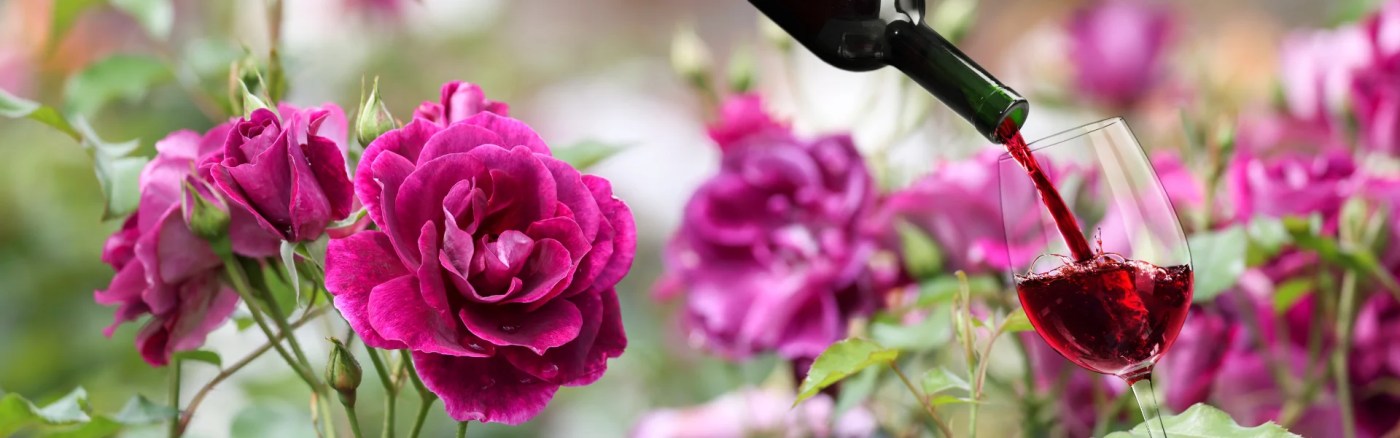
When we think of floral aromas in wine, white wines get all the credit. Their florals are bright and immediate, easy to catch right from the first pour.
Red wine is different. Its floral aromas sit layered beneath dark fruit, spice, and earth — subtle, yet entirely worth seeking out.
Having spent years working with flowers, I naturally find myself searching for familiar scents in a wine glass by sheer habit. Those aromas live in my memory — and once they’re in yours, they start showing up in the glass too.
Unlike vibrant white wines, however, red wines tend to keep their beautiful floral aromas tightly tucked away. Why can they be so elusive?
Why Floral Aromas in Red Wine Stay Hidden
White wine florals are highly volatile by nature. Compounds like linalool or geraniol rise from the glass immediately, which is why a white wine can smell almost heady in the first few seconds after pouring.
Red wine, however, expresses these floral notes in a completely different way. These delicate aromatic molecules become intimately bound within a heavy, complex polyphenolic matrix woven from tannins and anthocyanins.
This structural bond slows the release of these volatile compounds. By holding them back until the wine is fully ready, it allows these hidden floral aromas to unfold slowly and elegantly as the wine opens up over time.
When they finally emerge, they share space with dark fruit, oak, leather, and earthiness, all wrapped in the heavy grip of tannins. The flowers are undoubtedly there; they simply choose not to push to the front.
And the flowers themselves are different. White wine reaches toward white and yellow blooms, bright and clean-edged, whereas red wine runs deeper, in color and in character.
Two Flowers Worth Finding First
These are the first two of six floral aromas in red wine — and the most immediately recognizable of the group.
Violet
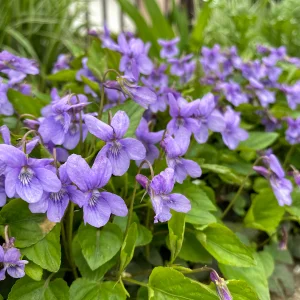
Violet is one of the most distinctive floral aromas in red wine. When it appears, it tends to announce itself.
When you hear that a red wine smells like violets, you might picture that little potted plant on a windowsill, wondering why you could never smell anything from it. You’re right — that plant has almost no scent.
In wine terms, violet refers specifically to the sweet violet, Viola odorata, native to Europe and Asia, where it grows along woodland edges and hedgerows. Its scent is cool, powdery, and faintly sweet, with a thread of earthiness underneath.
Beta-ionone, the aromatic compound behind it, behaves in a curious way. Unlike ordinary olfactory fatigue, where the brain simply tunes out a lingering scent, ionone compounds briefly desensitize the very receptors in the nose upon contact.
This is why the scent of violet seems to flash brilliantly and then vanish into thin air. When it happens, just step back, take a fresh breath, and return to the glass. The violet will be blooming there once again.
Even more fascinatingly, research has shown that a significant portion of the population may have reduced sensitivity to beta-ionone, due to a genetic variation in an olfactory receptor gene. If violet has always seemed elusive to you in the glass, that may be why.
Where to find violet
A young Cabernet Sauvignon from Napa or a Bordeaux blend carries it with striking clarity — fresh, dark, and cutting right through the fruit. In the region’s finest expressions, violet often appears alongside graphite and pencil shavings, a classic Bordeaux signature.
Syrah from the northern Rhône — Côte-Rôtie, Hermitage, and their neighbors — carries violet differently, threaded through black pepper and something savory and untamed.
Pinot Noir from Vosne-Romanée in Burgundy expresses it more as a perfume — floral and luminous against the red fruit.
Malbec and Petit Verdot also carry it reliably, often with more weight than delicacy.
Rose
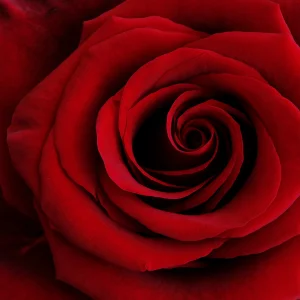
Rose is one of the most recognizable floral aromas in wine — and in red wine, it wears an entirely different face.
In white wine, rose tends to emerge like a living petal, fresh and lively. In red, it deepens into something more concentrated and settled, closer to a dried blossom or a drop of rose oil.
Where to find rose
Gamay from Beaujolais carries it with the gentlest touch — fresh and dewy, like petals set on cool water. Young Nebbiolo has its own vibrancy; in a Langhe Nebbiolo, the aroma arrives bright and very much alive.
In aged Barolo, the rose doesn’t disappear with time. It dries into something older and more layered, winding through tar, leather, and dark earth. That contrast — a delicate flower blooming through something so dark and untamed — is part of what makes aged Barolo so arresting.
Pinot Noir carries rose more lightly and transparently, woven through red currant and raspberry in a way that feels almost luminous.
Sangiovese from Tuscany and Grenache from the southern Rhône both carry it too: the Sangiovese tart and vivid, the Grenache rounder, sun-warmed, and generous.
Continue to Part 2
Violet and rose — two flowers that have been part of wine’s language for centuries, yet still surprise when they rise from the glass.
In Part 2, four more florals await: peony, lavender, hibiscus, and iris — each revealing how floral aromas in red wine can capture not just a single blossom, but the memory of an entire landscape. Part 2 also includes a practical guide to temperature, glassware, and pairing.
Continue reading: 6 Floral Aromas in Red Wine — Part 2
Wine. Flowers. The Art of Living Well.
© VinFloria · All rights reserved.
Leave a Reply