
Every wine is shaped by time. But some wines feel like drinking time itself. Rioja is one of them, and it is what kept drawing me back.
Rioja speaks in two souls. One is bold and modern, built on concentration and immediate power. The other is classical, refined through extended aging and rooted in a deep respect for time.
It was this traditional side that won me over. These wines arrive with gentle oxidative depth, restrained tannins, and a vibrant acidity that holds everything in quiet balance.
When you fall in love with a wine, you want to walk the land where it was born. That pull brought me to Rioja. I flew through Paris to Bilbao and drove south into the rolling vineyards.
In Haro (pronounced AH-ro), devoted, family-owned wineries cluster within walking distance of a historic train station in a district known as the Barrio de la Estación.
Four Iconic Wineries in Haro, Rioja
Rioja is a vast wine region. Its capital, Logroño, anchors the center, with fine producers spread across the landscape. But this story begins in Haro.
These wineries owe their location to timing: when the railway reached Haro in the 1860s, phylloxera was devastating France. Bordeaux merchants moved south, set up beside the tracks, and brought their winemaking techniques with them. When they left, local families took over and built the iconic bodegas that define Spanish wine today.
Whether you are looking for deeply aged Gran Reservas or elegant Tempranillo, these four legendary producers are the essential starting point for anyone exploring the wineries in Haro, Rioja.

CVNE, Compañía Vinícola del Norte de España (est. 1879)
I arrived on a December weekday, driving south from Bilbao into fog so dense the road kept vanishing. As the Ebro valley drew closer, the mist only deepened. By the time I reached CVNE, the morning was still and cold, and I hadn’t passed another visitor.
Brothers Eusebio and Raimundo Real de Asúa founded the winery in 1879. A fortunate printing error long ago turned the acronym into the brand name Cune, pronounced “COO-nay,” and that is how most of the world knows it today.
Now in its fifth generation, CVNE has grown into one of Spain’s most respected wine groups, farming over 500 hectares across Rioja and beyond. Even so, the group produces around eight million bottles a year, meaning roughly half its red grapes still come from long-term contract growers. Yet this historic complex in Haro remains the heart of the operation.
The core Cune Crianza and Reserva deliver remarkably consistent, classic Rioja at accessible prices. Monopole, registered in 1915, stands as Spain’s oldest white wine brand.
The estate’s crown jewel is Imperial, a label created in the 1920s for the British market and named after the “Imperial Pint” bottle it originally shipped in. Made only in exceptional vintages, the Imperial Gran Reserva gained global recognition when its 2004 vintage was named Wine Spectator’s Wine of the Year.
Visiting: A long stone wall leads to the entrance, opening into a small garden and a dimly lit stone tasting room. Book in advance to see the famous Eiffel Cellar, designed by Gustave Eiffel’s studio in the late 19th century.

Bodegas Muga (est. 1932)
After a quick lunch in the town center of Haro, I made my way to Bodegas Muga at the end of the main avenue.
Founded in 1932 by Isaac Muga and Aurora Caño, the house is now in its third generation. The name means “border” in Basque, fitting for a house that has always walked the line between tradition and forward thinking.
Muga operates its own full-scale cooperage, the only one in Spain dedicated to producing new barrels at this scale — roughly 2,000 a year in both French and American oak. Behind the winery, raw oak staves stand stacked along the courtyard wall, air-drying for two to three years before they ever hold a drop of wine.
The lineup covers a remarkable range, from the bright Blanco and Rosado to the signature Reserva with its baking spices and polished oak. Torre Muga shifts toward a bolder, more structured style.
Prado Enea Gran Reserva draws from vineyards at roughly 600 meters and ages at least seven years before release. Aro delivers pure concentration and precision from vines over 60 years old.
The tasting room feels more like a well-curated wine shop than a formal tasting salon. They set me up at a quiet corner table, and I took my time, while locals kept dropping in for bottles.
Visiting: For a deeper look at the aging cellar with over 14,000 barrels and the cooperage where every barrel is built by hand, book a guided tour well in advance.

R. López de Heredia Viña Tondonia (est. 1877)
Walking along Avenida de Vizcaya, red geraniums and ornate details on a traditional facade caught my eye. There it was: López de Heredia.
In front of the facade, a striking structure resembling a wine decanter serves as the wine shop and visitor center. The pavilion was designed to house the winery’s original 1910 World’s Fair stand. The most traditional winery in Rioja, fronted by one of the most avant-garde pieces of architecture in the region.
Founded in 1877 and now in its fourth generation, the estate farms 170 hectares of its own vineyards and has never purchased a single grape from an outside grower. Where most Rioja producers, even those with hundreds of hectares, rely on contract fruit to meet their volumes, López de Heredia chose to make only as much wine as its own land can give.
More than 13,000 American oak barrels fill the underground cellars. Three in-house master coopers maintain and, when needed, build them — favoring careful repair over new oak to preserve the wines’ character. Wines rest five to ten years before release, and current vintages on the market are often more than a decade old.
Viña Tondonia Reserva comes from a 100-hectare vineyard along the Ebro River, set on alluvial clay and limestone. It delivers what traditional Rioja does at its finest: low alcohol, lifted acidity, and a complexity that keeps revealing itself for years.
The Gran Reserva, both red and white, pushes the aging even further. The Viña Tondonia Blanco Gran Reserva ages ten years in barrel before release and ranks among the rarest white wines produced anywhere.
Visiting: Tours are strictly limited and by appointment only. The cellar tour descends fifteen meters underground into vaulted corridors lined with cobweb-covered bottles spanning decades. Allow about two hours, bring a warm layer, and book months ahead. It is worth every effort to arrange.
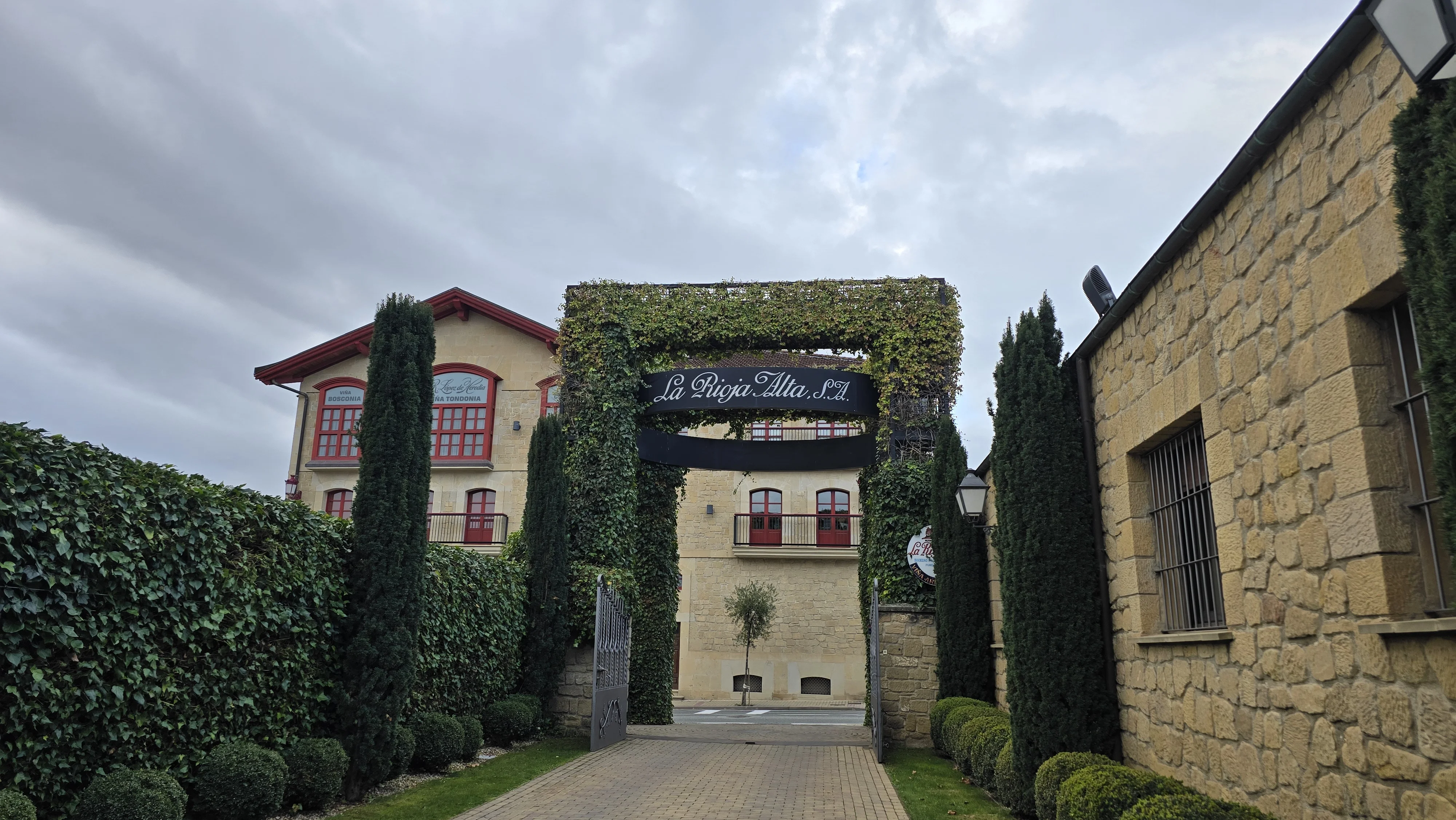
La Rioja Alta S.A. (est. 1890)
The gate reads La Rioja Alta S.A. Step through and the grounds open up to the winery buildings and a standalone wine bar tucked to one side.
Five Riojan and Basque families founded La Rioja Alta in 1890, and the mission from the beginning was clear: grow the best fruit, age it longer than anyone else, release nothing before its time.
That discipline still defines the house. La Rioja Alta is the only bodega in Rioja producing three distinct Gran Reserva wines. At any given moment, the cellars hold over 50,000 barrels and 6.4 million bottles, roughly eight years of sales, waiting.
The range begins with Viña Ardanza Reserva, a Tempranillo-Garnacha blend and one of Rioja’s most beloved wines.
Viña Arana, elevated to Gran Reserva status with the 2012 vintage, offers an elegant entry into the category with 95% Tempranillo and 5% Graciano.
Gran Reserva 904, commemorating the 1904 merger with Bodegas Ardanza, adds Graciano for deeper structure. Gran Reserva 890, honoring the founding year, ages six or more years in American oak and reaches the market only in the best vintages.
Both 890 and 904 drop the leading “1” to avoid confusion with vintage years.
Visiting: La Rioja Alta runs one of Rioja’s most established wine tourism programs. Even without a tour, a standalone wine bar by the parking area offers tasting by the glass or bottle alongside local cheeses and jamón.

Wineries in Haro: Finding the Soul of Rioja
Seven wineries clustered around a single historic railway station. That is what makes Haro’s Station District unlike anywhere else in the wine world. Beyond the four featured here, Gómez Cruzado, Bodegas Bilbaínas, and Bodegas RODA complete the district, each with its own rhythm and history.
The Station District is only the beginning. Beyond Haro, the true scale of Rioja reveals itself. Two-lane roads wind from village to village, connecting hill to hill across a vast and rugged landscape.
Through Rioja Alta, where Haro sits, and into the higher slopes of Alavesa toward the Sierra de Cantabria, the terrain turns to pale limestone, wild grasses, and exposed rock. It is not a soft countryside, and that untamed character is mirrored in the wines: in their restraint, their firm acidity, and the long aging that defines every bottle.
Outside Spain, the prestige bottles draw all the attention. Locally, however, Reserva remains the heart of everything. It is the wine people actually drink, the benchmark producers speak of with the most pride, and where the value is extraordinary.
I love the grand bottles of Rioja as much as ever, but I returned home with a deeper appreciation for Reserva, where Rioja truly lives. And it all started around that train station in Haro.
Wine. Flowers. The Art of Living Well.
© VinFloria · All rights reserved.