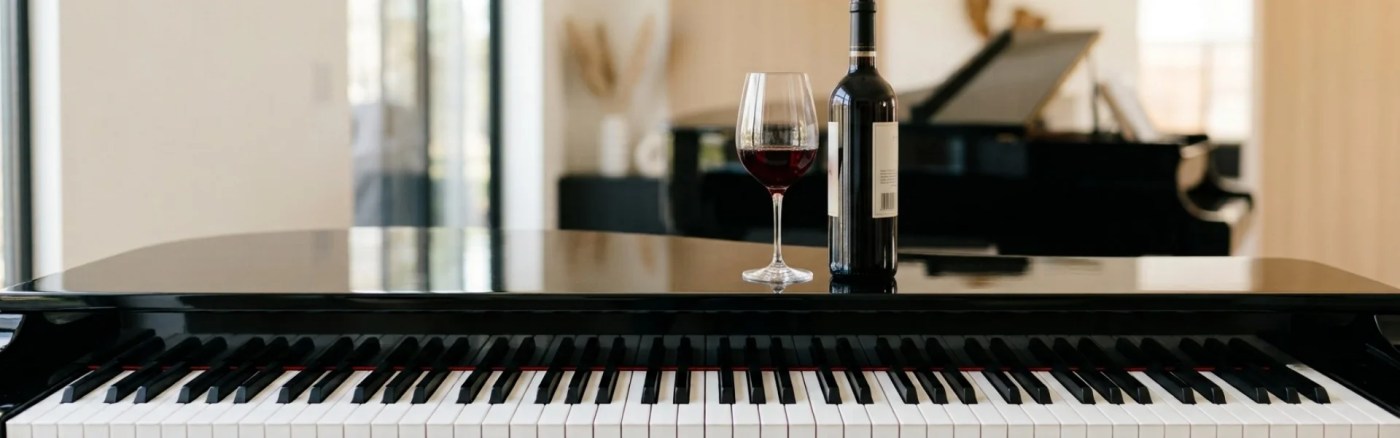
A wine label caught my eye at a local wine shop: Cuvée Chaupin.
Crafted by Domaine de la Janasse, this exceptional Châteauneuf-du-Pape comes entirely from century-old Grenache vines in France’s southern Rhône. It is one of my personal favorites, though rarely found on local shelves. Thrilled by the discovery, I pulled it from the rack and brought it straight to the register.
On the drive home, with the bottle resting securely in the passenger seat, I selected a Chopin nocturne. Sharing the car with both Chaupin and Chopin felt like a charming coincidence.
As the music played, a thought crossed my mind: Did Chopin enjoy wine?
That question quickly broadened. Which composers truly loved wine, and what role did it play in their creative lives?
The Language They Share
For anyone who loves both classical music and fine wine, the language they share is a delightful revelation.
In music, a single tone is a note. In wine, an individual aromatic is a note as well, whether floral, citrus, earthy, or mineral. Other terms like structure, body, harmony, balance, and finish flow naturally between the two worlds.
Yet the connection goes deeper than vocabulary. Both are arts built on time. Just as a piece evolves from one movement to the next, a fine wine unfolds its layers slowly over time. Neither yields its depth to impatience.
This shared nature explains why wine has long served as both comfort and muse to composers.

The Composers Who Loved Wine
Each composer’s relationship with wine was as distinct as the music they wrote.
Beethoven — The Last Glass He Never Had
Among the composers who loved wine, none left a more poignant final chapter than Ludwig van Beethoven.
Wine ran deep in his family. His grandfather worked as a court musician while trading in wines from the Rhine and Moselle regions. Growing up in Bonn, a city on the banks of the Rhine, the young Beethoven was surrounded by Riesling from the start.
When he moved to Vienna, it was only natural that he gravitated toward the wine-producing villages just outside the city. He composed while walking through the vineyards along the Danube and spent many evenings at the Heuriger, the traditional Viennese wine taverns.
Even after losing his hearing completely, his love for wine never faded. Notes about wine appear frequently in the conversation books he used to communicate with friends. Isolated by silence yet living close to the vines, he completed some of his greatest works during these years, including the Ninth Symphony.
In his final days, a failing Beethoven sent one last request: a few bottles of his beloved Rheingau Riesling. A case of twelve arrived the day before he died. It was already too late.
His last recorded words were a quiet sigh: “Pity, pity, too late.”
Chopin — The Passion He Fought to Keep
Frédéric Chopin loved wine as well. His letters to close friends are peppered with Bordeaux, Tokaj, and Champagne. Wine was one of his everyday pleasures.
But tuberculosis took that pleasure away. While recovering at a monastery in Mallorca, his health declined to the point where he could not enjoy even a single glass. In a letter to his friend Fontana, he joked about his condition: “I drink no coffee, nor wine, only milk. I look like a maiden.”
Yet even through the fevers and the solitude, Chopin never put down his pen. It was during this period that he completed his masterful 《Preludes, Op. 28》.
After returning to Paris, Chopin continued to compose the piano works we cherish today. During this time, he wrote to a friend asking for a case of Tokaj. At the time, it was a wine beloved by the Polish aristocracy. As his health waned, he surely wished to hold onto the memories and inspiration that wine brought him.
Some of the most beloved works in the history of music were completed by an artist too frail to hold a glass. For Chopin, wine was a passion he fought to keep alive even as life itself was slipping away.
Mozart — Champagne and an Aria
Wolfgang Amadeus Mozart was a composer of an entirely different temperament. Endlessly energetic and naturally sociable, he never stopped creating. In a life that ended at thirty-five, he left behind more than six hundred works, burning with a brightness that never dimmed.
Mozart had a particular fondness for Champagne. According to notes left by his father, Leopold, he often enjoyed it even during the day. Always attuned to high fashion, Mozart delighted in pairing fresh oysters with Champagne, the era’s ultimate aristocratic luxury.
The vibrant energy of wine and celebration comes through vividly in his opera Don Giovanni. In Act I, the title character sings the aria “Fin ch’han dal vino”, a breathless piece about drinking through the night to fuel his conquests.
Lasting barely a minute and twenty seconds, this explosive burst of energy earned the nickname “Champagne Aria,” named for its swift tempo and effervescent notes that recall the fizz of bubbles rising in a glass.
An aria of such lively spirit could only have been born from a composer who truly understood the vigor that wine brings.
Brahms — A Symphony Born in the Vineyards
Some wine lovers go beyond the glass. They visit the regions, walk the vineyards, and seek to understand the land and the people behind the wine. Johannes Brahms was that kind of wine lover.
At twenty, the young Brahms traveled along the Rhine for several months, journeying from Mainz through the Rheingau, home to the village of Rüdesheim, and on to Düsseldorf to meet Robert and Clara Schumann.
Passing through this storied German wine region, he came to know its Riesling vineyards and terroir firsthand, deepening a love for wine that would remain with him for the rest of his life.
As his understanding of the Rheingau deepened, he formed close friendships with wine merchants who distributed the region’s whites across Germany. Wherever he lived, he regularly received samples to taste and kept detailed notes on the wines he loved. On his many trips to Italy, he enjoyed Italian wines just as much, developing a lasting affection for Sicilian Marsala.
One summer in his middle years, Brahms settled in Wiesbaden and grew close to the von Beckerath family in nearby Rüdesheim, vineyard owners and accomplished musicians. Surrounded by vineyards and Riesling that summer, he composed his Third Symphony, a work he would later call his “Wiesbaden Symphony”.
The vineyard paths Brahms walked as a young man still remain in Rüdesheim today, marked as the Brahmsweg, inspiring all who walk it.
Much like the peaceful landscapes and pastoral vineyards he loved, his music reaches us not through grand gestures, but through the quiet, contemplative stillness of a walk in the woods.
Rossini — The Artist of Music and the Table
Few composers lived with as much flair as Gioachino Rossini. Sociable, witty, and always the life of the party, he was as much an artist at the table as he was on the stage.
The man behind The Barber of Seville left the opera house behind after writing thirty-nine operas by the age of thirty-seven. He spent his remaining years traveling between Italy and Paris, devoting himself entirely to gastronomy. In Paris, his Saturday dinner parties became a staple of high society.
Chefs of his day honored his refined palate by naming dishes after him. The most famous, Tournedos Rossini, pairs seared beef tenderloin with foie gras and black truffle. “Alla Rossini,” meaning “in the style of Rossini,” became an official culinary term, eventually listed in the French culinary encyclopedia.
A handwritten menu preserved in Florence’s renowned library, the Biblioteca Medicea Laurenziana, reveals his instinct as a wine connoisseur. He paired Madeira with charcuterie, Riesling with cold pie, Bordeaux with fried dishes, and Champagne with the roast, harmonizing flavors by intuition rather than rule.
In his later years, he wrote light piano and vocal pieces simply for friends, playfully titling them Péchés de vieillesse (Sins of Old Age). Its fourth volume includes sets like Four Hors d’Oeuvres and Four Desserts, with movements wittily named after radishes, anchovies, and figs.
Yet for all his passion for wine and gastronomy, wine rarely made an appearance in his operas. Perhaps for Rossini, music was a rigorous stage demanding artistic perfection, while the dining table was a space to simply enjoy life as it was.
Through the quiet longing of Beethoven and the midnight labors of a restless Mozart, wine remained a constant companion at their side, offering solace in solitude and a spark in creation.
Their works continue to breathe across time, not just because of the notes they wrote, but because of the humanity they poured into them.
Composers who loved wine, and the wine lovers who love them.
What connects us still, across time and space, is music and wine.
Wine. Flowers. The Art of Living Well.
© VinFloria · All rights reserved.
Leave a Reply