
Sheep in the vineyard?
Every time I spot them grazing between the bare vines in early spring, a sudden wave of clarity hits me. In fact, I usually can’t resist pulling over.
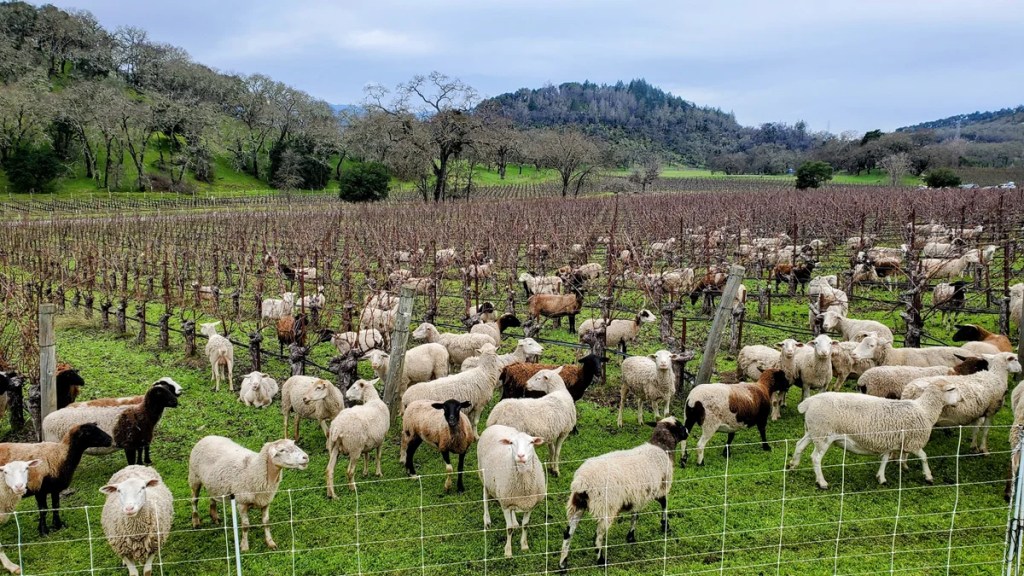
The moment I step closer, a chorus of baas erupts, echoing through the quiet vines like a welcoming committee. There’s something about that sight — and that sound — that still catches me, every single time.
Of course, having livestock in the vineyard doesn’t automatically guarantee a winery is 100% sustainable. But it does make me wonder: Who owns this land, and how deep does their commitment go?
Because when it’s done right, it means someone is farming with real intention — for the soil, for the season, and for whoever comes after. And that always shows up in the glass.
These are six of the best sustainable wineries in California. From northern Sonoma to the coastal hills of Santa Barbara, here are the stories worth knowing before you visit.

Littorai Wines — Sebastopol, CA
There is no sign at the entrance. Just a dirt road, a gate with a code. And beyond it, a working farm producing some of California’s most precise Pinot Noir and Chardonnay.
The founder trained in Burgundy — and came back to California knowing exactly what he was looking for. He found it on the Sonoma Coast — a mosaic of soils, fog patterns, and coastal exposure.
Littorai has farmed biodynamically since the beginning. The 30-acre Gold Ridge Estate outside Sebastopol is a proper farm. Cows for compost, sheep for grazing, herb gardens for biodynamic preparations, and eight acres of woodland left entirely untouched. The winery itself is built from straw bales.
It was véraison — the Pinot Noir just beginning to deepen into color. A dog in the sheep pen started barking as we passed. Within seconds, the entire flock of sheep joined in — bleating across the hillside in one long, rolling wave.
In the barn nearby, drums of herbal tea were quietly fermenting for use as biodynamic vineyard spray. Bundles of lavender and other dried plants lay in neat rows across the tables, waiting for the next season.
Standing there, it just felt like a farm that knew exactly what it was doing.
The wines reflect that. Cool-climate, restrained, mineral — built for the table and the cellar rather than the immediate impression. The single-vineyard Pinot Noirs are among the most Burgundian expressions California has to offer.
What to look for: The Pivot Pinot Noir or the Sonoma Coast Chardonnay
Visit: By appointment only — littorai.com
Spottswoode Estate — St. Helena, CA
Look for an old Victorian house half-hidden behind the vines on the western edge of St. Helena. You’ve found it.
The estate was founded in 1972 and has been farming with quiet conviction ever since. The first Cabernet Sauvignon was released in 1982, and by 1992 Spottswoode had earned CCOF organic certification — when the idea was still considered risky.
Today the estate is run by the founder’s daughters. The vineyard is divided into twenty-two individual blocks, each farmed with the kind of individual attention that large estates can rarely afford. Spottswoode received Demeter biodynamic certification in 2020, and is Napa Valley’s first certified B-Corp winery.
The Estate Cabernet Sauvignon is the flagship — structured, precise, and built to age. Exactly like the estate itself.
What to look for: The Cabernet Sauvignon for a cellar-worthy benchmark, or the Sauvignon Blanc for a brilliant white.
Visit: Private visits by appointment only — spottswoode.com
Frey Vineyards — Redwood Valley, CA
In 1962, two doctors from New York purchased a 95-acre ranch at the headwaters of the Russian River in Mendocino County and planted vines without synthetic inputs. They weren’t making a statement. Instead, they were simply farming the way they believed land should be farmed.
What grew from that decision is now American wine history. Frey Vineyards became the country’s first certified organic winery in 1980, and in 1996 received Demeter biodynamic certification — the first in the United States.
Today, four generations of the family live and work on the property. Ninety percent of the 1,000-acre ranch is preserved as natural habitat.
What sets Frey apart is a commitment that goes beyond certification. Their wines are crafted entirely without added sulfites, relying instead on wild, indigenous yeasts and natural settling rather than animal-based fining agents. Vegan, gluten-free, and made with a level of transparency that is genuinely rare in the industry.
The style here leans toward honesty over polish — wines that taste of where they came from rather than where they were finished. At their price point, they are remarkable.
What to look for: The Biodynamic Field Blend for an authentic expression of the estate, or the Organic Pinot Noir for something more approachable.
Visit: Tasting room open daily, no reservation required — freywine.com
Ridge Vineyards — Cupertino, CA
Most people driving Highway 280 through Silicon Valley have no idea that one of California’s most important wineries sits 2,300 feet above them.
When I first drove up to Monte Bello before GPS — winding higher and higher on a narrow road through oak and chaparral, genuinely unsure I was heading the right way. And then — the ridge opens up, and there it is.
The Monte Bello vineyard was first planted in the 1880s. A group of engineers from Stanford Research Institute re-bonded the winery in the early 1960s. What followed became California wine history — including a first-place finish at the Judgment of Paris re-tasting, thirty years on.
What often goes unmentioned in Ridge’s celebrated story is the farming. The winery has been organic since the late 1990s, and the entire Monte Bello estate is now 100% certified organic.
Their winemaking philosophy, which they call “pre-industrial,” is rooted in native yeast fermentation, minimal sulfur, and complete transparency — every additive and process listed on the back label, vintage after vintage.
The limestone soils here are uncommon in California, producing a Cabernet that is more mineral, more structured, and more restrained than the classic Napa style. These are wines that open slowly — and reward every year you give them.
Standing on that ridge on a clear day, watching the fog sit over the Bay below while the vines caught the afternoon sun above — the wine makes so much more sense when you’ve seen exactly where it comes from.
What to look for: Monte Bello for the long game, or Lytton Springs — the Zinfandel-based blend from Dry Creek Valley — as a more accessible entry into Ridge’s world.
Visit: Open daily, two locations — Monte Bello (Cupertino) and Lytton Springs (Healdsburg) — ridgewine.com
Tablas Creek Vineyard — Paso Robles, CA
The story of Tablas Creek begins in a friendship — between the Perrin family of Château de Beaucastel in Châteauneuf-du-Pape, and Robert Haas of Vineyard Brands.
After years of searching for a place in California with similar soils and climate to the southern Rhône, they settled on the limestone hills west of Paso Robles in 1989.
They imported vine cuttings directly from Beaucastel — Mourvèdre, Grenache, Syrah, Roussanne, Viognier, and others — and made them available to any grower who wanted them.
Those cuttings helped launch what became known as the California Rhône movement. Tablas Creek didn’t just participate in that story. In fact, it wrote much of it.
Certified organic in 2003 and Demeter biodynamic in 2017, Tablas Creek became the world’s first Regenerative Organic Certified vineyard in 2020.
Tablas Creek dry-farms the entire estate. A mobile herd of sheep, alpacas, and guard donkeys grazes the vineyard rows. Owl boxes, beehives, and flowering cover crops support a full working ecosystem.
Tablas Creek sits about fifteen minutes west of town, tucked into the oak-covered hills of the Adelaida District at around 1,500 feet elevation. Every time I drive out here, the rolling hills dense with oak trees follow me around every curve. The air grows cooler and quieter with every mile.
In early summer, the days are warm and golden, but the Pacific — just twelve miles away — keeps the nights cool enough that you feel it even at noon.
That crisp freshness shows up in the wines. The tasting felt as timeless as the landscape, and what stayed with me was the sheer purity — bright, unforced, nothing artificial.
What to look for: Esprit de Tablas for the full expression of the estate, or Côtes de Tablas Blanc — a white worth discovering.
Visit: Open daily, walk-ins welcome — tablascreek.com
Alma Rosa Winery — Sta. Rita Hills, CA
The founder did something methodical after returning from Vietnam. He studied Burgundy’s climate data, then drove the back roads of Santa Barbara County with an agricultural thermometer wired to his car.
He recorded temperatures by season and time of day, searching for a place cold enough to grow serious Pinot Noir.
In 1971, he found it. The vineyard he planted that year — Sanford & Benedict — became the first Pinot Noir vines in the entire Sta. Rita Hills, and the cuttings from those vines shaped much of what the region is today.
Alma Rosa came later — named for an 1839 land grant on which the El Jabali estate sits. El Jabali was the first certified organic vineyard in all of Santa Barbara County. That commitment has never wavered, through changes in ownership.
The wines from El Jabali are precise and cool-climate. The Pinot Noir carries real restraint and structure. The Chardonnay has a saline, mineral lift that speaks unmistakably of the maritime edge.
This is where the Sta. Rita Hills story began. And it still tastes that way.
What to look for: El Jabali Pinot Noir for the estate’s most focused expression, or the Sta. Rita Hills Chardonnay for a beautifully balanced introduction to the region.
Visit: Two tasting rooms — Buellton and Solvang — open daily — almarosawinery.com
Different Roads, Same Direction

These six wineries span the length of California — different in every way that matters on the surface. Yet, the exact same quiet conviction runs through all of them.
None of these estates farm the way they do because it’s fashionable. The best organic and holistic wineries in California have been at it for decades, long before “sustainability” became a marketing buzzword.
What keeps them on that path isn’t a business strategy. It’s conviction. The kind that grows from watching the same piece of land simply thrive, season after season, when treated with care.
A wine grown this way isn’t just a different product. It’s a different intention altogether. Think of the care that goes into the soil, the seasons, the harvest. Much like a home-cooked meal made with the cleanest ingredients. Prepared by hands that genuinely care about what they are putting on the table.
That kind of attention has a distinct taste. And once you’ve recognized it, you’ll never stop looking for it.
Leave a Reply