
“Would you like some wine with your dinner?”
The flight attendant’s voice gently pulled me away from the wine list. On any long-haul flight with wine service, the list always gets more of my attention than it probably should. Call it professional habit or personal obsession. That day was no different.
Spotting a wine I knew felt like running into an old friend in a foreign city. Full of anticipation, I ordered a glass and took a sip. But the fruit wasn’t there and the finish was rough and sharp, nothing like the wine I knew.
That happened quite a while ago, but I still remember the moment I first wondered why wine tastes different on a plane.
What on earth happens to wine at 35,000 feet?
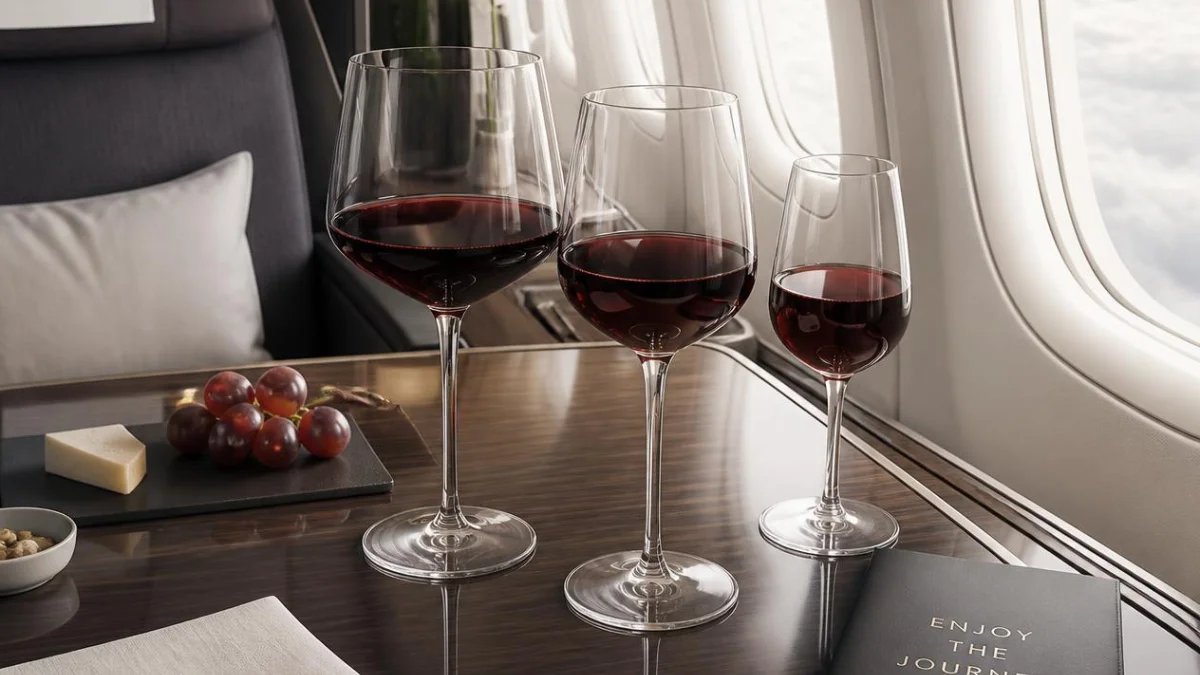
Why Wine Tastes Different on a Plane
Once the cabin door closes and the plane takes off, your body enters an environment entirely different from the ground. For a wine taster, three main factors come into play.
Dry Air
On the ground, we feel comfortable in 40 to 60 percent relative humidity. Inside an airplane, that number drops to just 10 to 20 percent. Lips dry out and skin tightens, making you reach for lip balm or moisturizer more often.
That same dryness affects the inside of your mouth, slowing the delivery of flavor to your taste buds. It dries out your nasal passages as well, dulling the olfactory receptors that are critical for sensing aroma.
Think of a bad cold or a fever, where a dry mouth and a stuffed nose dull both your taste and smell. Food and drink lose their character, and the wine in your glass is no exception.
Pressure
Lufthansa commissioned a study testing taste perception inside a simulated flight cabin.
The results showed that participants perceived roughly 20 percent less sweetness and 30 percent less saltiness, while their sensitivity to sourness and bitterness remained largely unaffected.
Lower cabin pressure also affects aroma itself. Volatile compounds evaporate faster at low pressure, so the bouquet in your glass fades more quickly than it would on the ground.
Noise
Cruising cabin noise hovers around 85 decibels. Researchers at Cornell University found that ambient sound at this level further suppresses sweetness, adding to the effects of low pressure. Even noise works against sweetness in the air.
So what does all of this mean for the wine in your glass?
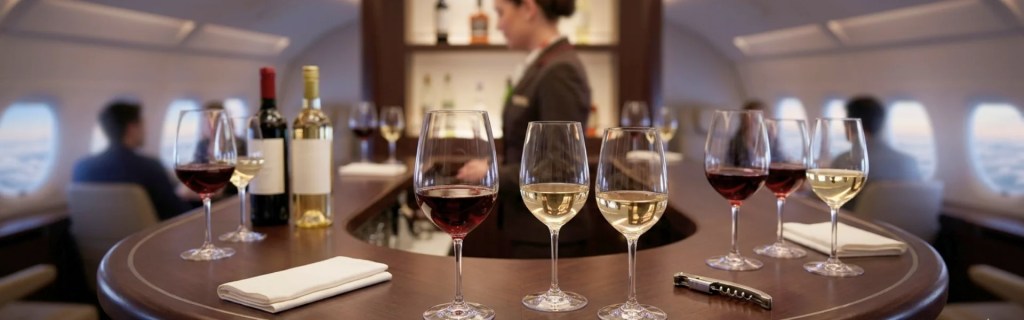
How Wine Tastes Different on a Plane
These aren’t just lab findings. Airlines already apply the science, adjusting the seasoning of in-flight meals to compensate for dulled palates at altitude. How much they adjust varies, but no one in the industry questions the effect.
The Shift in Wine’s Flavor Balance
When sweetness and saltiness fade at altitude, acidity and bitterness become relatively more pronounced, shifting the flavor balance we perceive in wine.
Sweetness has a way of masking other tastes, and umami is the one it masks most. So when sweetness perception drops on a plane, umami can come forward more freely. This probably explains why umami-rich foods such as tomato or mushroom hold their flavor at altitude, or even taste better.
What makes this more interesting is a finding from the same Cornell study. Beyond the effect of reduced sweetness, cabin noise itself was shown to directly enhance umami perception.
All of these affect wine as well. The fruity character steps back, while acidity, bitterness, and umami become more noticeable.
When Saliva Fades, Tannins Bite Back
Saliva forms a thin protective layer inside your mouth that keeps everything feeling smooth. When you drink a tannic red wine, the tannins grab onto the proteins in that layer and strip it away. That is where the familiar drying, gripping sensation comes from.
When there is enough saliva, the proteins can handle tannins while maintaining lubrication. In the dry cabin air, saliva production drops, and with it, the protective film thins out. Tannins meet less resistance, so the drying, tightening sensation on the palate can feel noticeably stronger than it would on the ground.

Wines to Drink at Cruising Altitude
Understanding the science changes the way you approach the wine list at 35,000 feet. The key is finding a wine built for these conditions.
Reds
Look for red wines with generous fruit, soft tannins, a round texture and approachable style.
Grenache-based blends from the southern Rhône or Spain, ripe Pinot Noir, smooth Merlot, and fruit-forward Zinfandel or Syrah all tend to deliver enough fruit presence to stay balanced, even at altitude.
Older, well-aged wines are where it gets a little tricky. Their softened tannins, savory profile, and richer umami compounds align well with the cabin environment. But their complex yet delicate tertiary aromatics that make these wines special are harder to pick up in the dry cabin air.
That doesn’t mean you should pass on an aged wine in the cabin. If you see one offered on a premium wine list, by all means enjoy it, just knowing the wine isn’t quite showing its best. It would be a shame to misjudge the beauty of a wine that took years to mature based on a single glass at altitude.
If it leaves you curious, try it again on the ground where it truly comes alive. You may find yourself with a completely different impression.
Whites
Rich, full-bodied whites with good depth do well. A well-made Chardonnay with balanced oak, a textured Viognier, a Riesling or a Chenin Blanc with a touch of residual sweetness. Wines with aromatic intensity tend to push through the dry cabin air more effectively.
On the other hand, very lean, high-acidity whites, such as unoaked styles with crisp minerality and subtle aromatics, tend to lose their charm when the nose can’t do its job. What feels refreshing on the ground can come across as thin and sharp at altitude.
Sparklings
Surprisingly enough, sparkling wine is one of the best choices you can make at altitude.
The effervescence stimulates the palate in ways still wines can’t, and the CO₂ rising from the bubbles helps carry aromas, partially making up for what the dry cabin air takes away.
That said, not all sparkling wines are equal here. As with still wines, fruit-forward styles work best. Blanc de Noirs with its higher proportion of red grapes, Rosé styles, or Extra Dry(Sec) with a touch more sweetness all do well, and standard Brut holds up nicely too.
Very dry styles like Brut Nature or Extra Brut, with their minimal dosage, may feel uncomfortably sharp and acidic in the cabin.
One more thing worth knowing, lower cabin pressure causes the CO₂ to escape faster than it would on the ground. Keeping that in mind makes the experience all the more interesting.
A Better Glass for Your Next Flight
The wine list at 35,000 feet may look a little different from now on, and the wine you reach for may not be the same one you would have chosen before.
The bottle, chosen with altitude in mind, might just be the most thoughtful glass you pour yourself all year.
Wine. Flowers. The Art of Living Well.
© VinFloria · All rights reserved.
Leave a Reply