
The best organic wineries in California tell you who they are before you even taste the wine.
Drive through California wine country in early spring, and you’ll run into the most unexpected vineyard crew: sheep and goats grazing between the dormant vines.
They look so peaceful, I can never just drive past. I pull over, slowly step closer, and the first one to notice me calls out. Within seconds the whole flock joins in, filling the vineyard with a chorus of baas like a little welcoming committee.
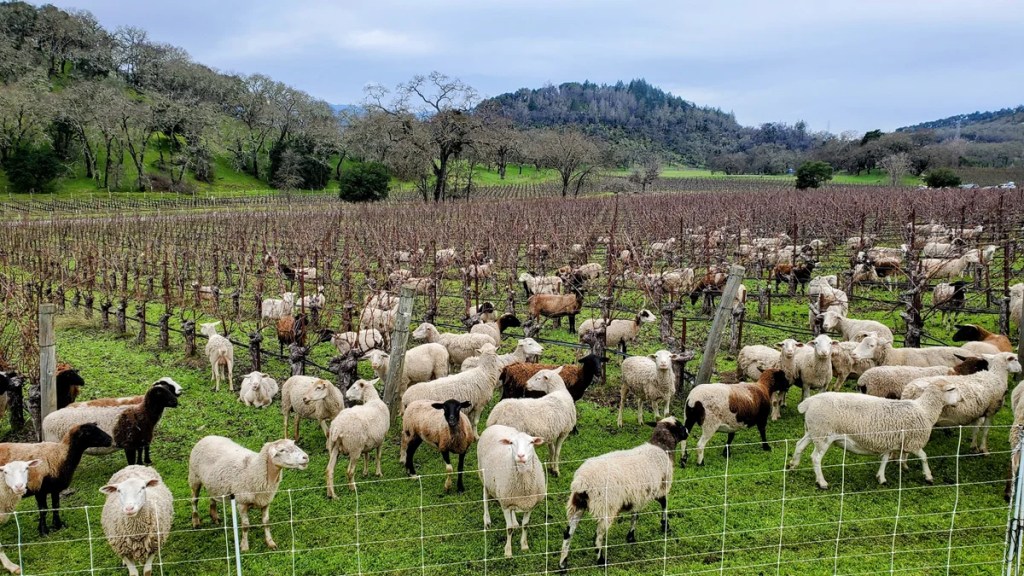
Seeing sheep in a vineyard means someone is farming the land with real intention, caring for the soil, respecting the vine’s own rhythm, and farming not just for today but for the next generation. And that kind of commitment always shows up in the glass.
Many wineries across California farm like this. Here are six worth knowing before you visit.

6 Organic Wineries in California
From the fog-cooled ridges of Sonoma to the coastal hills of Santa Barbara, all of them are worth the visit.
Littorai Wines — Sebastopol, CA
There was no sign at the entrance. Just a dirt road and a coded gate. Fortunately, the winery had sent clear directions ahead of time, so finding it was not difficult.
I entered the code, drove through, and Littorai quietly revealed itself. A working farm known for producing some of California’s most precise Pinot Noir and Chardonnay.
The founder trained at several prestigious domaines in Burgundy and became the first American to be appointed winemaker at a Burgundian estate. Returning to California, he and his wife purchased a hilltop property along the Sonoma Coast and began farming under biodynamic methods, among the most rigorous approaches in viticulture.
When I first visited, harvest was only weeks away. The Pinot Noir clusters were darkening beautifully, just weeks from being picked. As I walked through the vineyard and circled back, I passed mounds of natural compost slowly breaking down on the other side.
A herd of goats grazed across the open land. Nearby, a barn held drums of herbal tea fermenting for vineyard pest control. Further in, dried oak bark, botanicals, and lavender were laid out in neat rows, all part of the preparations for natural fertilizer.
Even the farming calendar and bottling schedule follow the lunar cycle, representing a biodynamic commitment that extends from the vineyard all the way into the cellar.
Their Pinot Noirs are floral and red-fruited, with the vibrant acidity and structure that allow them to age gracefully. The Chardonnays are equally restrained, driven by minerality and a saline freshness rather than oak. Littorai’s single-vineyard wines remain some of the most Burgundian expressions California has to offer.
What to look for: The single-vineyard Pinot Noirs and Chardonnays
Visit: By appointment only, littorai.com
Spottswoode Estate — St. Helena, CA
If you spot a Victorian house half-hidden behind the vines on the western edge of St. Helena in Napa valley, you’re there.
The property’s roots go back well over a century. The first vines were planted at the foot of the Mayacamas Mountains in the 1880s.
The estate changed hands several times before a young couple, a doctor and his wife, purchased it in the early seventies, beginning its modern chapter.
The first Spottswoode Cabernet Sauvignon was released exactly one hundred years after the estate’s founding. Organic farming began shortly after, a bold move at a time when the idea was still considered risky in Napa Valley.
CCOF organic certification, Demeter biodynamic certification, and Napa Valley’s first B-Corp certification followed in turn, extending their commitment to social and environmental responsibility well beyond the vineyard.
Today the estate is led by their daughters. The vineyard is divided into more than twenty individual blocks, which means they tailor the pruning, canopy, and harvest timing block by block. That hands-on precision is what makes them different, and it shows in every bottle.
What to look for: The Estate Cabernet Sauvignon and the Sauvignon Blanc.
Visit: Private visits by appointment only, spottswoode.com
Frog’s Leap Winery — Rutherford, CA
The founder grew up on a dairy farm in western New York and studied winemaking at UC Davis. In the late eighties, after launching his own label, he earned the first CCOF organic certification for a vineyard in Napa Valley.
Every vine has been dry-farmed from the start. His belief is simple: vines forced to root deep produce more honest fruit, and organic soil holds the moisture to make that possible.
Today the winery lives in a historic red barn in the heart of Rutherford, originally built in the 1880s. Behind the barn, four acres of certified organic gardens grow vegetables, herbs, flowers, and fruit trees year-round.
For the Garden Tasting, guests gather under an arbor overlooking the gardens and the Mayacamas Mountains. I can say it is one of the most relaxed tasting experiences in Napa Valley.
The philosophy here is balance, restraint, and respect for terroir. In a valley where most Cabernets push well past fourteen percent alcohol, Frog’s Leap consistently stays under that line.
The result is elegance over power, and a Rutherford character that speaks of soil. A second generation has now stepped in, carrying the same conviction forward.
What to look for: The Estate Cabernet Sauvignon and the Sauvignon Blanc.
Visit: By reservation, frogsleap.com
Ridge Vineyards — Cupertino, CA
High above Silicon Valley, tucked into the Santa Cruz Mountains, sits one of California’s most important wineries.
I still remember my first drive up to here before GPS, navigating a narrow mountain road with no certainty I was even on the right path, until the ridge suddenly opened up.
The vineyard was first planted in the 1880s, but it was a group of Stanford Research Institute engineers who re-bonded the winery in the early sixties. The Monte Bello Cabernet they produced placed fifth at the famous 1976 Judgment of Paris, then took first place when experts re-tasted the same wines three decades later.
What often goes unmentioned in Ridge’s story, however, is the farming. The winery began its transition to certified organic viticulture over a decade ago, and today the entire estate is farmed under strict 100% organic standards.
Their winemaking philosophy, which they call ‘pre-industrial,’ roots itself in native yeast fermentation, minimal sulfur, and complete transparency. They proudly list every additive and process on the back label, vintage after vintage.
The limestone soils at Monte Bello are uncommon in California, producing a Cabernet that is more mineral, more structured, and more restrained than the classic Napa style. These are wines that reveal themselves over years, rewarding every bit of patience.
Ridge’s second home, Lytton Springs, sits along a quiet country road near Healdsburg in Sonoma County. From the terrace, guests can taste while looking out at old-vine Zinfandel blocks over a century old. Monte Bello wines are available for tasting there as well.
What to look for: Monte Bello (Cabernet blend), Monte Bello Chardonnay, and Lytton Springs (Zinfandel blend)
Visit: Open daily, two locations; Monte Bello (Cupertino) and Lytton Springs (Healdsburg). ridgewine.com
Tablas Creek Vineyard — Paso Robles, CA
The story of Tablas Creek begins in a friendship between the family behind Château de Beaucastel in Châteauneuf-du-Pape and an American wine importer who had spent years bringing their wines to the States.
After years of searching for a place in California with similar soils and climate to the southern Rhône, they settled on the limestone hills west of Paso Robles in the late eighties.
They imported vine cuttings directly from Beaucastel—Mourvèdre, Grenache, Syrah, Roussanne, Viognier—and made them available to any grower who wanted them. Those cuttings helped establish Paso Robles as California’s Rhône Valley. Tablas Creek didn’t just participate in that story. It wrote much of it.
Organic certification came in the early 2000s, biodynamic certification followed over a decade later, and by 2020, Tablas Creek had become the wine world’s first Regenerative Organic Certified vineyard.
The entire estate is dry-farmed. A mobile herd of sheep, alpacas, and donkeys grazes the vineyard rows, while owl boxes, beehives, and flowering cover crops support a full working ecosystem.
Drive fifteen minutes west of Paso Robles toward the Pacific, and you’ll find Tablas Creek where the air cools and the oaks thicken along the road. That cool climate shows in the wines: pure fruit, lively acidity, and a transparency that lets the terroir speak for itself.
What to look for: Esprit de Tablas (the flagship Rhône-style red blend) and Esprit de Tablas Blanc.
Visit: Open daily, walk-ins welcome, tablascreek.com
Alma Rosa Winery — Sta. Rita Hills, CA
With a background in geography from UC Berkeley, the founder set a distinctly different tone right from the start.
He analyzed Burgundy’s climate data, then drove the back roads of Santa Barbara County with a thermometer attached to his car, recording temperatures by season and time of day, searching for a place cold enough for great Pinot Noir.
What he found was a transverse valley where the mountains open to the Pacific, funneling cool marine air straight inland. It would become known as the Sta. Rita Hills.
In 1971, he and a botanist partner planted what would become Sanford & Benedict, the first Pinot Noir vines in the entire Sta. Rita Hills. Sitting on a north-facing hillside above the Santa Ynez River, it was a place no one else had thought to plant.
Other winemakers followed, many using cuttings from Sanford & Benedict to start their own vineyards. The region grew around it.
Alma Rosa was the founder’s next chapter, a fresh challenge after his time at Sanford Winery in the early 2000s. At Alma Rosa, he chose to focus heavily on organic farming, and the estate vineyard, El Jabali, became the first certified organic vineyard in all of Santa Barbara County.
The wines from El Jabali are precise and cool-climate. The Pinot Noir carries real restraint and structure, with a depth that unfolds slowly in the glass. The Chardonnay has a saline, mineral lift that speaks right to the coast. Both reflect a winemaking philosophy that values clarity over volume.
What to look for: El Jabali Pinot Noir and the Sta. Rita Hills Chardonnay
Visit: Two tasting rooms; Buellton and Solvang, open daily, almarosawinery.com

Wines That Capture Nature
From Napa Valley to the coastal hills of Santa Barbara, these six producers represent the true soul of California wine.
Each has its own grapes, soil, and story, but their shared vision goes beyond sustainability as a trend. It is rooted in patience, craft, and a deep respect for the land.
Hope your visit becomes a meaningful journey into their philosophy and wines.
Wine. Flowers. The Art of Living Well.
© VinFloria · All rights reserved.
Leave a Reply